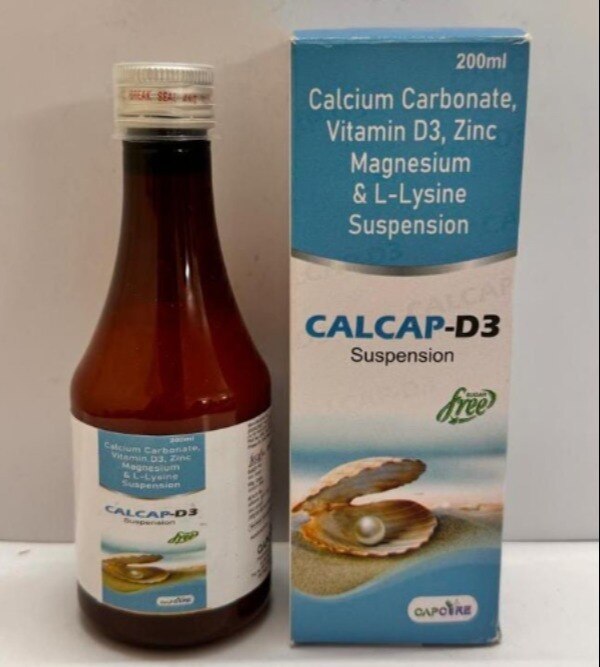
A calcium-D3 syrup brief is incomplete until it defines elemental calcium, the calcium salt, vitamin D3 strength, dosage volume, suspension behaviour, pH, testing and stability evidence. By the end, you will be able to compare a ready formulation with a customised or reformulated product and prepare a more rigorous manufacturing brief.
Key takeaways
- Define elemental calcium, vitamin D3 strength and the intended user first.
- Choose a solution or suspension that stays uniform through the full dose.
- Match the measuring device and directions to the patient’s age and dose.
- Review stability data, licences and batch records before commercialising.
Start with the calcium dose, salt and intended user
Define elemental calcium per 5 mL or 10 mL before choosing a salt. State the vitamin D3 strength in IU and micrograms, intended user, age-specific dose, maximum daily intake and any added nutrients. A calcium syrup formulation development brief also needs a target pH, serving volume, flavour, sweetener, preservative, viscosity and sugar-free requirement.
| Salt | Approximate elemental calcium | Composition consequence |
|---|---|---|
| Calcium carbonate | About 40% | High calcium yield, but poor water solubility usually requires a suspension with controlled particle size, wetting and redispersibility. |
| Calcium citrate | About 21–24% | Requires more salt for the same elemental dose and can change taste, dose volume and physical stability. |
| Calcium lactate hydrate | Substantially less | Requires a larger salt quantity and may alter viscosity, flavour and serving volume. |
- Calculate salt quantity from the elemental target: divide the required elemental calcium by the salt’s calcium fraction. Do not label only the weight of calcium carbonate or citrate.
- Decide whether the product must be a true solution or an oral suspension. If particles remain, specify “shake well” and select a measuring cup, spoon or oral syringe that delivers the intended volume.
- Choose the cholecalciferol format and protect its small dose from being masked by the much larger calcium dose. Plan separate controls: a stability-indicating chromatographic assay for vitamin D3 and a calcium assay such as complexometric titration or ICP-OES.
- Set sweetener, flavour, suspending agent, preservative and viscosity targets for the actual user, because children, pregnant adults and elderly users do not share the same tolerability or dosing needs.
Choose a solution or suspension that patients can dose reliably
A clear bottle does not prove uniform dosing. Calcium carbonate is poorly soluble in water, so a Calcap D3 syrup formulation using it must be designed as an oral suspension, with controlled particle size, wetting, sedimentation and redispersibility. A true solution needs a sufficiently soluble calcium salt.
| Design route | Physical behaviour | Development controls |
|---|---|---|
| Calcium carbonate suspension | Particles settle during storage | Wetting agent, xanthan gum or cellulose polymer, controlled viscosity, mixing energy and shake-to-dose directions |
| Calcium citrate or another soluble salt solution | Clearer, but solubility and pH limits still apply | Compatibility studies, pH specification and protection against precipitation |
| Oil-based vitamin D3 | Can separate from an aqueous vehicle | Emulsifier, droplet-size control and light-protective packaging |
| Water-dispersible D3 powder or beadlet | Disperses more readily in water | Uniform distribution, assay recovery and stability in the finished vehicle |
Calculate elemental calcium, not compound weight: multiply the calcium-salt quantity by its elemental-calcium fraction, using the declared hydrate or anhydrous form. Control cholecalciferol separately; its microgram or IU dose is tiny beside the calcium dose, so use a stability-indicating chromatographic assay for D3 and a separate calcium assay.
Sweetener and flavour must mask chalkiness without increasing viscosity beyond accurate spoon or oral-syringe delivery. Select preservative, polymer and pH together; pH affects solubility, preservative efficacy and suspension behaviour. Test sedimentation, redispersibility and dose uniformity after repeated shaking.
Match strength, measuring device and directions to the patient group
One strength can serve multiple patient groups only when its concentration produces a measurable, clinically appropriate volume for each group. Define the dose as elemental calcium, not merely calcium-salt weight: calcium carbonate supplies about 40% elemental calcium, calcium citrate about 21–24%, and calcium lactate hydrates substantially less.
A salt change therefore alters the required millilitres, taste and suspension behaviour.
| Patient group | Development decision | Direction the label must support |
|---|---|---|
| Children | Use an age- or weight-based dose that does not require fractions below the device scale | State the permitted age range, dose in mL, frequency and maximum daily amount |
| Pregnant adults | Confirm the intended elemental-calcium and vitamin D3 intake alongside other prenatal supplements | State the serving volume, daily frequency and advice to avoid duplicate supplementation |
| Elderly users | Check swallowing ability, dexterity, renal considerations and medicine-separation needs | Give an easy-to-read dose, timing instructions and interaction warnings where applicable |
The brief must specify elemental calcium per 5 mL or 10 mL, vitamin D3 in IU and micrograms, serving volume, age-specific doses, maximum daily intake and whether the product is a solution or suspension.
Require a calibrated oral syringe or dosing cup, identify its graduations, and instruct users to shake a suspension thoroughly before every dose. Do not use a kitchen spoon.
Compare a ready formula, custom development and reformulation
Choose a ready formula when its calcium salt, elemental calcium per 5 mL or 10 mL, vitamin D3 strength, serving volume and patient group already match the brand brief.
Commission a new calcium syrup formulation when those fundamentals do not fit; modify an existing Calcap-D3 concept when the core composition works but its performance needs correction.
| Option | Select when | What to verify and accept |
|---|---|---|
| Ready formula | You need speed and the intended label matches an established composition | Confirm calcium assay, D3 assay, microbial results, stability data, taste, viscosity and measuring-device compatibility. You inherit its salt, sweetener and dose limitations. |
| Custom development | You need a new strength, calcium salt, sugar-free platform, flavour or age-specific dose | Define solution versus suspension, target pH, preservative system and redispersibility. Budget for development batches, analytical validation and stability studies. |
| Reformulation | An existing Calcap-D3 concept is commercially close but fails on taste, sedimentation, dosing or shelf life | Change only justified variables, then repeat assay, microbial, viscosity, preservative-effectiveness, in-use and stability testing. A “small” excipient change can alter dissolution or preservative availability. |
For calcap syrup for formulation development, calcium carbonate requires controlled particle size, wetting and suspension systems because it is poorly soluble; relabelling it as a solution will not fix sedimentation. Treat sugar-free development as a separate platform, since polyols change viscosity, osmolality, mouthfeel and gastrointestinal tolerance.
Assay calcium and the much smaller D3 dose with separate, suitable methods.
Audit the manufacturing and stability package before commercialising
A GMP certificate is not proof that a calcium-D3 syrup will scale successfully. For Calcap syrup contract manufacturing, require the product-specific transfer file, validated methods, stability data and licence evidence before approving a commercial batch.
1. Obtain the quantitative formula, elemental-calcium calculation, raw-material grades, particle-size limits, order of addition, mixing energy and time, homogenisation or milling settings, bulk hold time, filling parameters, cleaning procedure and in-process controls. A master formula without these details can produce sedimentation or dose-uniformity failure.
2. Request process-validation and cleaning-validation reports, analytical-method validation or verification, deviation and change-control procedures, batch-traceability records and the manufacturer’s authority to make the proposed product category. Signoret Pharmaceuticals Private Limited should be assessed against this evidence, not proximity to the buyer.
3. Define release tests for each batch: vitamin D3 assay by a stability-indicating chromatographic method; calcium assay by complexometric titration or ICP-OES/ICP-MS; appearance, pH, viscosity, specific gravity, fill volume, microbial limits, preservative content and, for a suspension, sedimentation, redispersibility and particle size.
4. Demand stability data in the final container at long-term 30°C/75% relative humidity and accelerated 40°C/75% relative humidity, with assay, degradation products, pH, viscosity, microbial quality, preservative performance and redispersibility tested. Add photostability and an in-use study after opening when the pack or label makes them relevant.
For Calcap syrup brand development Mohali, separately verify Indian classification, licence scope, approved laboratory arrangements, release responsibility, Punjab regulator requirements and post-approval change support. Check every calcium salt, vitamin D3 premix, sweetener, flavour, preservative and bottle supplier for specifications, certificates of analysis, audit history and lot traceability.
Related product
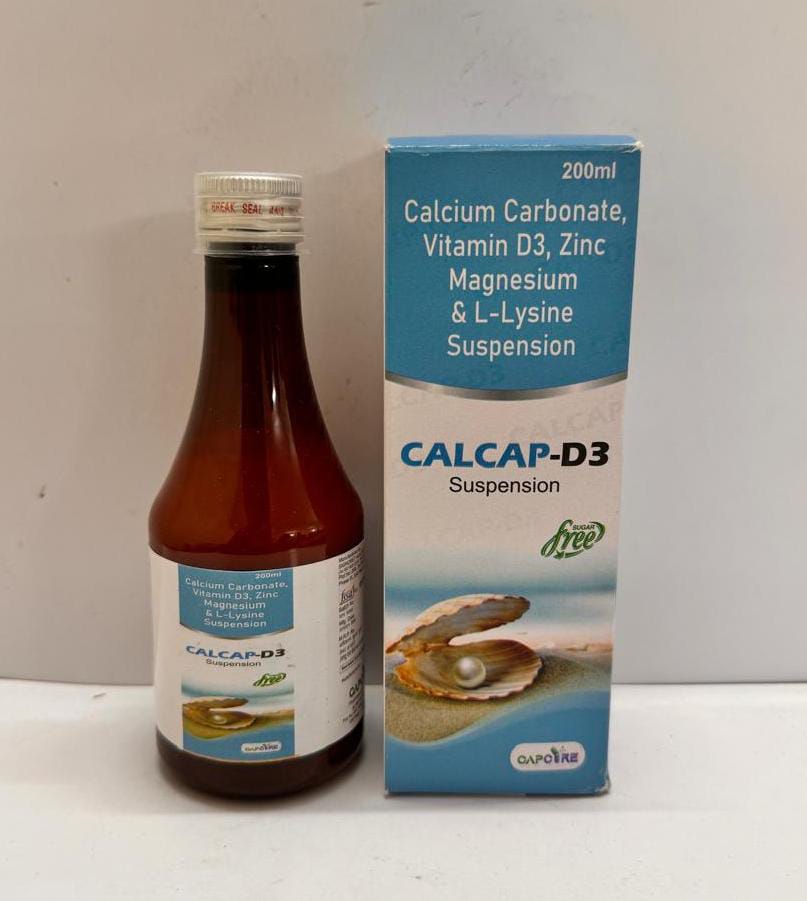 | Calcap-D3 Syrup Calcap-D3 Syrup is a tasty and effective blend of Calcium and Vitamin D3, specially formulated for children, pregnant women, and the elderly. View product → |
Frequently asked questions
What should a Calcap syrup formulation development brief specify?
Specify elemental calcium per 5 mL or 10 mL, calcium salt, vitamin D3 in IU and micrograms, intended user, age-specific dose, maximum daily intake, added nutrients, target pH, serving volume, flavour, sweetener, preservative, viscosity and sugar-free requirements.
How do you choose between a calcium solution and suspension?
Choose a solution when the ingredients remain dissolved at the target strength and pH. Choose a suspension when the calcium salt is insoluble, then verify uniformity, sedimentation, redispersibility and dose accuracy throughout shelf life.
How should the measuring device match the calcium syrup dose?
Match the device graduations to the prescribed volume, such as 2.5 mL, 5 mL or 10 mL. Provide an oral syringe when a spoon cannot measure the required dose accurately.
What should you compare in ready formula, custom development and reformulation?
Compare development time, control over strength and excipients, analytical and stability work, packaging compatibility, change-control needs and the evidence available for the selected formula.
Which documents should you audit before commercialising a calcium syrup?
Review the manufacturing licence, master formula, specifications, certificates of analysis, batch manufacturing and packing records, process controls, stability protocol and results, packaging compatibility data and release documentation.
Keywords